22.1.17

Raivavae's ceremonial paddles

Rurutu is not the kind of place you get to by accident. Our guests often have a specific reason for visiting. It is one of the perks of the job, I might not get to travel as much as my restless feet would really like to, but I do get to meet other travelers, and share their stories and quests. This week there was a Canadian visitor, a collector of Oceanian art, his motivation for visiting was a 19th century carved paddle that he had acquired at auction. I’m not sure he found what he was looking for, the distant past (pre-missionaries, i.e. early 19th century) is hopelessly obscured by the dramatic changes experienced in the Austral Islands and Polynesia more generally. Introduced European disease killed at least nine out of every ten people living in the Australs between the 1820s and 1840s, Christianization did the rest. In Rurutu, missionary accounts suggest that there may have been as many as 6,000 inhabitants prior to European contact, at the height of the epidemics some 200 survived! Woodcarving simply died out, Rurutu 'forgot' the fine art, once much admired by early European observers. Those remaining were more concerned with survival, besides, ancient customs were frowned upon by the Protestant missionaries. 
We are left with just the tip of an iceberg, odd fragments from a lost culture - Raivavae's ceremonial paddles are an example. The first paddle was received by the Peabody Museum in 1812. In total there are somewhere near a thousand in collections worldwide. They were probably collected between 1812 and 1842 and seem to have been the specialty of woodcarvers in Raivavae. What is interesting is that a large number of them were procured outside of Raivavae, other items such as fly whisks and drums were also procured in Tahiti. Suggesting an important trade of Austral Islands carvings.
 
Why these exquisite objects were originally produced is unclear, though the repeated motifs of men and women suggest a link with ancestry and/or fertility. The paddles have been long-studied by Rhys Richards, a New Zealander, who also passed through our guesthouse several years ago now, whilst writing his book Austral Islands: Art, History and Art History published in 2012. We were and are still more focused on A'a here, who has a whole dedicated chapter, but it motivated me to read in more detail. Later paddles were carved specifically as trade objects, but the detailed workmanship and presence of paddles prior to regular trade leave no doubt that they were originally valued cultural objects, but whether for use in dance or religious ceremony, we may never know.
The pictures shown here are of a paddle up for auction in California recently. It's a fabulous piece that sold for US$17,500, a fair bit more than the sailors who traded for it must have paid (often exchanging such objects for metal objects, clothing or fabric). 
 

20.1.17

More Polynesian gods

Other Tahitian gods included Ta’aroa and Tane, but also Ro’o, Tu, Hiro and ‘Oro.
Ta’aroa, Tangaroa in Maori mythology, was god of the oceans. Son of the Sky father and Earth mother, brother of Tane. He was driven to the ocean, which became his realm, by another brother, Tawhirimatea, god of storms. He was the creator of all sea life, some of his children came to land, Tane's realm. Tangaroa never forgave Tane for adopting his grandchildren. Thus, Maoris make offerings to Tangaroa before taking to the sea, or fishing, to appease his anger with them, Tane’s adopted children.
Ta'aroa by Bobby Holcomb
In the Society Islands, particularly Raiatea, Ta’aroa was elevated to the god of creation.  He existed before all else, inside his egg, alone in the nothingness. With a shake of his body he cracked the egg, he used the broken shell to form the rocks and sand. He then proceeded to create the rest of the earth, crying the oceans and rivers. He called forth craftsmen to sculpt the gods, Tane was the first, but more followed. Tane in turn put the sun, the moon and the stars in the sky. Ta’aroa then created man.

‘Oro was the son of Ta’aroa, he was worshipped by a powerful cult, centered on the marae Taputapuatea in Raiatea. It was the dominant cult in Tahiti, when the first European explorers set foot on the island.
He was a god of war, and legend has it that he lived on Mt.Pahia in Bora bora with his sisters (a place I visited and even camped, as a student collecting weevils!). 'Oro descended to earth on a rainbow, seeking a human wife.
His natural manifestation could be a green-red bird or light yellow thrush, much like the two native birds found in Rimatara!

In Hawaiian mythology Lono also descended to earth on a rainbow seeking a wife, (though this is seemingly coincidence, as his Tahitian counter-part is Ro’o). Captain Cook may have been mistaken for Lono by Hawaiians, a mistake that later proved fatal for him!
Intriguingly, because ancient Polynesians worshipped their ancestors, current day families still claim to trace their genealogies back to the gods. The more powerful your ancestor, the more powerful you were. Carved wooden or stone representations of ancestors, tiki, stood on marae (traditional sacred sites) and acted as a link between the world of gods and men. Only priests and chiefs were allowed to approach them, others could be put to death for such a sacrilege. Our old friend and family tiki A'a (here depicted by the London Missionary Society, demurely wearing a loin cloth) is such a god representation, maybe even of Ta'aroa. John Williams who gives us the first written trace, initially called him by the name A'a, but later used the name  "Ta'aroa te upoo vahu". Lets not forget that we live on marae Tararoa, just a small mis-prononciation away.


16.1.17

Polynesian Myths

Whilst working on my translations, I’ve become interested in Polynesian mythology. I hadn’t previously, though a little bit does rub off, simply from being here so long. I had already heard some plant myths - Polynesians believe that humans gave rise to plants.
One of my favorites is the breadfruit legend, in a time of famine in Raiatea, a husband and father, desperate to help his starving family turns himself into a tree, his head the fruit, his body and arms the trunk and branches, his hands the leaves. His wife and children, distraught to discover this ultimate sacrifice, gather the fruits to eat. 
The breadfruit
legend, by Sarahina
There are also a family of gods, some found across Polynesia, though their significance and importance vary. Their legends evoke images every bit as powerful as those found in Greek or Roman mythology.

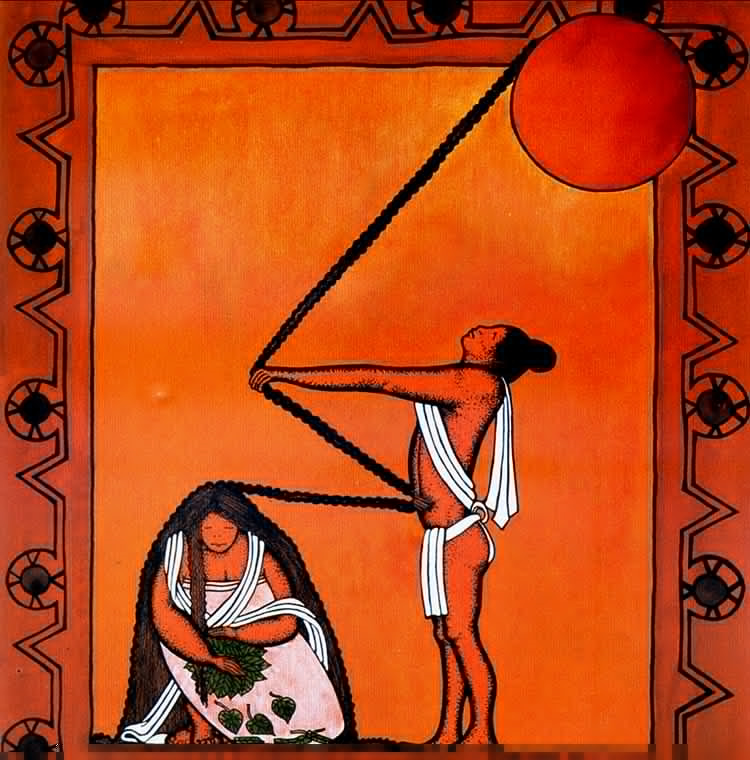
You may have heard of Maui, the demi-god who fished up islands and ensnared the sun (if only thanks to the recent Disney movie Moana, Vaiana in the French version), using rope made from his sister’s hair and a magical fishhook. Here is a striking painting of Maui catching the sun, the work of a famous local artist-musician Bobby Holcomb.

AirTahiti have been showcasing a legend, telling how the islands formed; once magical fish, hauled up from the depths by Maui, Hina and others.
This striking painting, by Vashee, a young artist from Tubuai, elegantly distills this story into image.

10.1.17

Welcoming in 2017!

Ia ora na i te matahiti api or Happy New Year!
January has been filled with the usual festivities, the Tere and Tomora'a 'are, my mother-in-law also welcomed a visiting member of the Parau family, from the Cooks. Aunty Silifu is slowly drawing all the threads of her huge family together, from across the Pacific.

The kids are back in school, the weather's still oppressively hot. I've got a  couple of new translation projects in the pipeline. Issue 93 of the Air Tahiti Magazine is out (here's the online version), with a fabulous article about Rurutu, the images are stunning, and Viriamu makes the opening page of it, a bit of local flavor!!!!
I'm also proud to say that, finally, after a decade of stalling, a big chunk of my PhD work is being published. Thanks in a large part to the perseverance and support of my supervisors George and Rosie, from UC Berkeley. It's almost twenty years now since I started my Pacific adventure, thanks to their generosity, willingly accepting a young undergrad into their lab and home in Hawaii. I certainly wouldn't be here without them!