Showing posts with label taro. Show all posts
Showing posts with label taro. Show all posts
18.5.12
Rain, rain, rain rain!
Beautiful rain!
 Today the skies are grey and humidity is 100%! It's cold and damp, but I don't mind. I indulged myself and the guests this lunch time, by preparing a good stout Taro chowder (based on a corn chowder recipe, with a few shrimp and taro chunks added for good measure). I love preparing Taro chowder when the weather is gloomy, it's SOOO thick and delicious, it really does warm the cockles of your heart, or was it just that I was a bit heavy handed with the white wine! Another reason why I'm not feeling down because of the rain, is because of my new gardening projects! I'm getting a bit of green-thumb fever here, and am trying to plant anything I can lay my hands. Of course sometimes it works, sometimes not, but it's fun to try and there are so many exciting plants that could grow here, if you could just get hold of the seeds/cuttings. I have some kiwi fruit seeds, longan (a bit like a lychee only different) and cape goosberry seeds planted up and have my fingers firmly crossed. I've been battling to get a bit of a veggie patch going outside our back door, and it's coming along, the basil, strawberries, green beans and tomatoes are all in, now it's a matter of defending the seedlings from the dogs/pigs/birds or whatever it is that goes rooting through my beds when I'm not looking.......I'll wait a few weeks, but hopefully I'll have something to show you......

18.7.11
Heiva (part II)


....we went down to Moerai, to the festival ground by the harbor last week, to check out the taro-pounding competition, as well as the fecculent weighing. A good time was had by all!

7.12.08
Taro - the food of (Rurutu) Gods!
Taro is easily the most important crop vegetable here in Rurutu. Each of the three major villages has extensive taro fields, with each family sharing the irrigated taro patches. I think the taro patch in Avera is one of my favorite places on the island, you can almost feel the history seeping up through the ground when you're there, and it's great to watch the men working away in the fields (women are not supposed to cultivate taro in Rurutu)

Taro fields, Avera, Rurutu - photo: A. Machado
At one point in Rurutu's history stealing taro was an offense that could be punished by death and several of the tribal wars started as a result of taro theft. This may date from a time when there were many more inhabitants on the island - Cook's records estimate that there may have been as many as 20,000 people living on Rurutu when he passed by (that's about 10x more than today!).

Taro has been in cultivation for about 10,000 years in Papua New Guinea, making it one of the oldest crop plants. It's very easy to grow, you just re-plant the cut stem and top corm, after harvesting.

Viriamu demonstrating how to plant taro, photo:R.Gouiran
About 10% of the world's population is reliant on taro as a diet staple. The Polynesians brought the root with them when they colonized the remote central Pacific. It is also widely cultivated in Hawaii, and indeed used to be considered to be the noblest of the food crops there. In Hawaiian legend the firstborn child of the daughter of father earth and her husband father sky was stillborn, the child was buried and there at the grave grew the first taro plant. Their second child, a healthy boy, gave rise to the human race. Hawaiian royalty adopted taro-leaf designs on their livery. There is a taro festival held annually in East Maui, Hawaii, to honor this sacred root - I'd love to check it out someday! In Hawaii taro is primarily eaten as poi, a slightly fermented taro paste. Here we do have poipoi, which is pounded fermented cooked taro, but it is of a much thicker consistency and is eaten in hunks, or tiromi which is grated taro that has been cooked in the Tahitian oven. But we mostly just eat taro boiled in water, in place of bread or other starch. It's great with coconut milk, and we often eat boiled fish with coconut milk and taro, with a dash of salt and lime.
However, I've been discovering that taro is not just a Polynesian thing, it is eaten across the humid tropics (Southeastasia, the wet tropics of Africa and Egypt, the West Indies and parts of South America). The ancient Romans even used to eat the root, imported from Egypt! It has many different names, here are just a few - dasheen, eddoe, gabi, kalo, dalo, culcas, guagui, callaloo, keladi, sato imo, cocoyam, arbi. There are clearly a large number of different varieties with slightly different sized or colored corms stems or leaves. There are also many ways of preparing taro - I have a wonderful recipe/history book from my last trip to Hawaii: Hawaii Cooks with Taro, by Marcia Mager, Alvin Huang and Muriel Miura (the taro-corn chowder is just wonderful) and I have some traditional recipes from friends and family, but I'm always ready to try something new! I would love to hear from you if you have any recipes to share....

Taro fields, Avera, Rurutu - photo: A. Machado

Our taro varieties - the red-stemmed bunches are 'mana ura' from Rurutu,
black-stemmed are a variety from Rapa
and the green-stemmed a variety from Rimatara.
Taro is a plant in the Aracaceae (Colocasia esculenta var. antiquorum), we eat the leaves (fafa - when cooked they have a delicate spinach-like flavor that I love) and most often the root or rather to be precise it's a corm (a bit like a super dense, violet, starchy potato). For some reason the soil in the Australs and particularly Rurutu yields a superior tasting/textured taro corm to Tahiti, so we often export to friends and family in Tahiti (even I can tell the difference, and I'm definitely a taro novice!). There are several varieties that are grown here, the most popular being 'mana ura' (translated literally it means 'red power', the variety has red stems and the corm has a good firm texture and purple hue).black-stemmed are a variety from Rapa
and the green-stemmed a variety from Rimatara.
Taro has been in cultivation for about 10,000 years in Papua New Guinea, making it one of the oldest crop plants. It's very easy to grow, you just re-plant the cut stem and top corm, after harvesting.

Viriamu demonstrating how to plant taro, photo:R.Gouiran
However, I've been discovering that taro is not just a Polynesian thing, it is eaten across the humid tropics (Southeastasia, the wet tropics of Africa and Egypt, the West Indies and parts of South America). The ancient Romans even used to eat the root, imported from Egypt! It has many different names, here are just a few - dasheen, eddoe, gabi, kalo, dalo, culcas, guagui, callaloo, keladi, sato imo, cocoyam, arbi. There are clearly a large number of different varieties with slightly different sized or colored corms stems or leaves. There are also many ways of preparing taro - I have a wonderful recipe/history book from my last trip to Hawaii: Hawaii Cooks with Taro, by Marcia Mager, Alvin Huang and Muriel Miura (the taro-corn chowder is just wonderful) and I have some traditional recipes from friends and family, but I'm always ready to try something new! I would love to hear from you if you have any recipes to share....
30.7.08
Heiva de Rurutu 2008
The heiva is a month long cultural festival celebrated every year across French Polynesia. In Tahiti it's a large and rather professional festival, but in the islands it remains charmingly rustic. This year was the first year that I've really done the whole heiva in Rurutu. The festival includes a huge variety of competitions ranging from sporting events like paddling,


stone-lifting,

and, of course, the bareback horse race along the beach.....


(Viriamu got third this year, but his little brother got first! It's supposedly a friendly race, but there's definitely some pride at stake)

There are also dance, singing, music, flower-arranging and weaving competitions, as well as the country-fair sort of things, the longest/heaviest bunch of bananas or taro root, coconut husking and taro-pounding competitions, all in all it's a lot of good fun for the whole family!!


a prize-winning bunch of bananas weighing in at >40kg
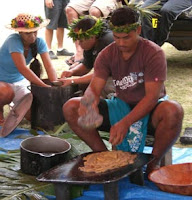
poi-poi making (taro-pounding)


manioc (tapioca) roots (above left), varieties of bananas and taro (above right)

a prize-winning bunch of bananas weighing in at >40kg

poi-poi making (taro-pounding)
3.11.05
Meanwhile back in Moorea
 So here I am back in Moorea, and it seems more and more like home now. The mosquitoes really are something else, but apart from that I was very glad to catch up with Viriamu and puppy! OK so now he looks more like a small dog rather than a puppy, with an extremely fine pair of ears, it's all very exciting ... I think he must have a little bit of Doberman in him, but your guess is as good as mine!
 As for the taro let's just say that it did not fare as well as the dog. I guess young taro needs care and attention, so two weeks without being watered was disastrous! Note that the rows that survived were under our leaky gutter.
4.10.05
About as interesting as watching taro grow
We hadn't been living in the house for more than two days when Viriamu went to work on the garden. Of course we have to have a taro patch, and some manioc, pineapple and papaya, for good measure. So here we have a couple of pictures of Viriamu transforming some apparently barren soil into a veritable tropical kitchen garden! You can be sure that I'll keep you posted on the progress of our taro patch. I am eagerly awaiting our first harvest!

 ....and just two weeks later

(OK so it's going to be 6 months, at least, before we can eat it, what can you do? Actually Viriamu gets his family to send ice chests full of frozen taro from Rurutu, lest we go without!)


(OK so it's going to be 6 months, at least, before we can eat it, what can you do? Actually Viriamu gets his family to send ice chests full of frozen taro from Rurutu, lest we go without!)
Subscribe to:
Posts (Atom)